
 AR
AR 

 February 28, 2025
Traditional Vehicles that use petroleum derivatives have dominated the global market for decades. Due to the availability of petroleum derivatives and the prosperity of the industries dependent on it, and over time, especially in the last two decades, environmental problems such as global warming and carbon emissions have begun to appear, which made many countries move towards relying on clean energy as one of the available solutions. Other considerations related to petroleum prices and problems in supply chains, especially in the recent pandemic, include the fact that many countries have seriously moved towards alternative energy, which can be generated and transported in ranges close to production centers. One of the most prominent examples is electric vehicles, which we will learn about in this article.
Conventional Vehicles at a Glance
In order to understand how electrical vehicles work, we will first learn how conventional vehicles, sometimes called gasoline vehicles, work. Conventional vehicles use fuel to provide the engine with the energy necessary to work. These fuels are petroleum derivatives, such as:
Petrol
Diesel
Gasoline
Conventional Vehicles are distinguished by their outstanding performance and suitability to different environmental conditions. However, the combustion of fuel inside the car's engine—a basic process of generating energy—results in harmful carbon emissions known as CO2 Emissions, as in Figure (1)

These emissions are increasingly harmful to the environment over time, reaching nearly 35 billion tons by 2019. Figure 2

How do electric Vehicles work?
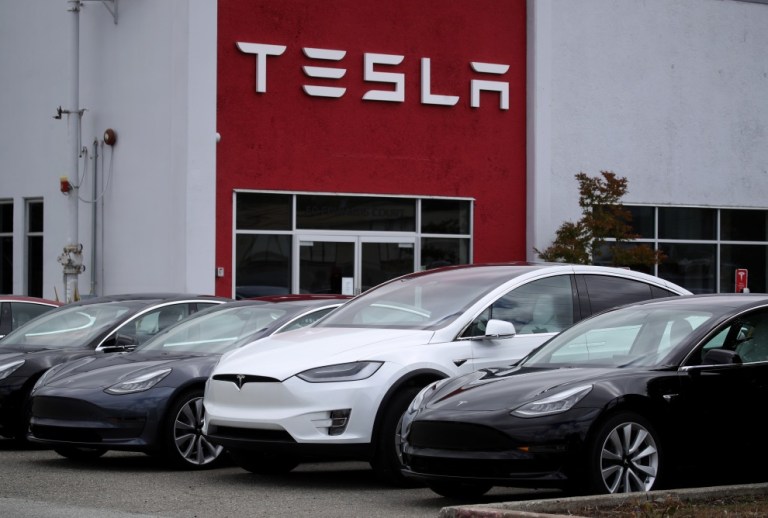
Electric Vehicles are one of the alternative options that use electricity as a main energy source. In the last decade, the research and manufacturing sector in this field has flourished. The most prominent manufacturers of electric vehicles are:
1. Tesla Figure (3)
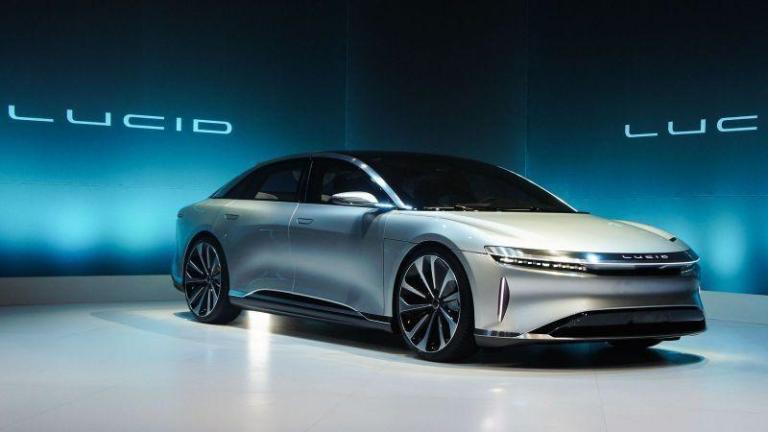
2. Lucid Motors
in which the Saudi Public Investment Fund invests. Figure -4
Electric and conventional vehicles share the same principles of movement and mechanics but differ in the source of energy that produces this movement, as electric vehicles use electricity as the primary source of energy instead of traditional derivatives from petroleum .
Types of Electrical Vehicles
1- All-Electric Vehicles
Fully electric vehicles have an electric motor instead of a conventional combustion engine, which means that there is no combustion process to generate energy, but there is a transition of energy from the electric state to the kinetic, and this explains the absence of exhaust repellents for combustion gases as in the traditional, which led the US Environmental Protection Agency to classify all fully electric cars as zero carbon vehicles.
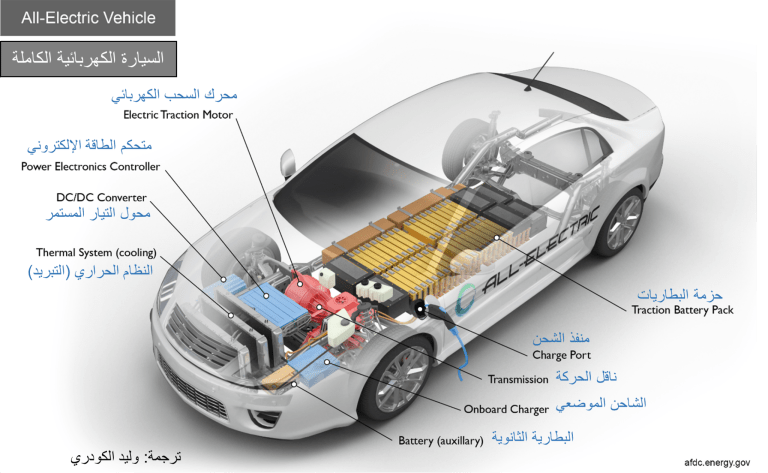
Complete electric vehicles have the following main components, as in Figure (5).
Battery Pack
A group of batteries that are connected to each other and store electrical energy to be used by the electric traction motor.
Electric Traction Motor
Using the electrical energy in the battery pack, this engine moves the wheels of the car, and some electric cars use generator engines that move the car and regenerate part of the power at the same time.
Power Electronics Controller
This unit controls the passage of electrical energy from the main battery pack to the electric motor, controlling the rotational speed and torque of the motor.
Transmission (electric)
transfers mechanical energy from
the electric traction motor to rotate the wheels.
Charge Port
This port allows connecting the main battery to the external charging system.
DC/DC Convertor
The electric vehicle is fed from a continuous-frequency and high-voltage electrical power source, and this device reduces the voltage of this energy to a lower voltage in order to charge the auxiliary battery and feed electronic components inside the vehicle, such as: navigation screen, audio systems, and odometer.
Auxiliary Battery
It aims to supply the necessary power to operate the electronic components of the vehicle., such as:
Onboard Charger
In case electrical vehicle is fed from an AC Power Supply, the on-board charger converts it into DC Power to be fed into the main battery pack. The on-board charger also connects to the charging equipment and monitors the properties of the main battery pack such as voltage, the amount of current generated, temperature, and charging status .. etc.
Thermal System (cooling)
This system regulates the temperature to ensure optimal performance of the vehicle's components.
Battery Pack
A group of batteries that are connected to each other and store electrical energy to be used by the electric traction motor.
Hybrid Vehicles
It integrates the characteristics of traditional and electric vehicles , as it operates mainly by means of an internal combustion engine next to an electric motor that uses the energy contained in the battery pack, and the batteries in these cars are not charged directly by an external source, but rather the battery is charged by reusing the wasted energy resulting from the brake pressure as well as by the internal combustion engine while it is working, and the additional electrical energy supplied by the electric motor and coming from the batteries provides the car with a small amount of energy to operate, the battery can also operate the additional loads and reduce the engine deceleration when stopping and these features together lead to better fuel savings without compromising performance.
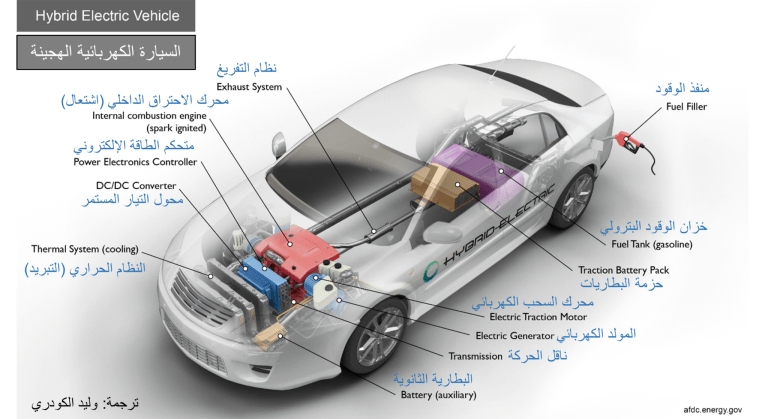
Hybrid electric vehicles differ from full electric vehicles in that they do not have a charging port and a local charger as well as have the following additional components, as in Figure (6):
• Fuel Filler:
It transfers petroleum fuel to the vehicle tank.
Fuel Tank (Gasoline):
Stores petroleum fuel to supply the engine when needed.
• Exhaust System:
This system discharges the carbon emissions resulting from the combustion of fuel inside the engine to the outside of the vehicle through the pipes (exhaust)
• Internal Combustion Engine (spark-ignited)
Fuel is mixed with air and injected into the engine with a spark ignition
• Electric Generator:
This generator generates electrical power using the rotational motion of the wheels as a result of braking pressure and sending it to the battery pack to recharge it, there are some hybrid electric cars that use the generator power at the same time to provide the vehicle with movement.
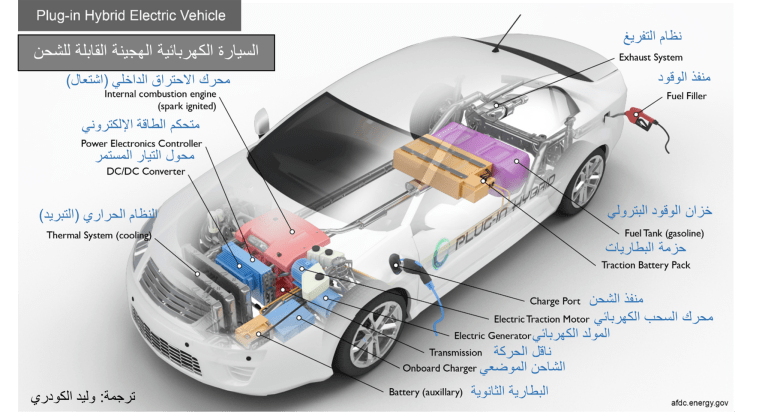
3- Plug-in Hybrid Electric Vehicles
It differs from the previous type in the possibility of charging the battery pack directly from an external source, which makes the size of the batteries larger, because the possibility of charging has become available and as a result, the reliance on the electric motor will become greater.
Rechargeable hybrid cars carry the same components of hybrid electricity and exceed them in only two components, which are as in Figure(7):
• Charge Port:
This port allows connecting the main battery to the external charging system.
• On board Charger:
In case electrical vehicle is fed from an AC Power Supply, the on-board charger converts it into DC Power to be fed into the main battery pack. The on-board charger also connects to the charging equipment and monitors the properties of the main battery pack such as voltage, the amount of current generated, temperature, and charging status .. etc.
4- Hydrogen Fuel Cell
Hydrogen Vehicles are similar to full electric vehicles in the mechanism of work. They both use electrical energy as a source of energy, but the difference is that hydrogen cars produce electrical energy internally in the car by means of a hydrogen fuel cell called Hydrogen Fuel Cell, where they are supplied with hydrogen from an external source and a chemical reaction occurs using hydrogen and oxygen to produce electrical energy and use it inside the vehicle, so they carry the same components of full electricity and exceed them in the following components, as in Figure (8): Figure (8)
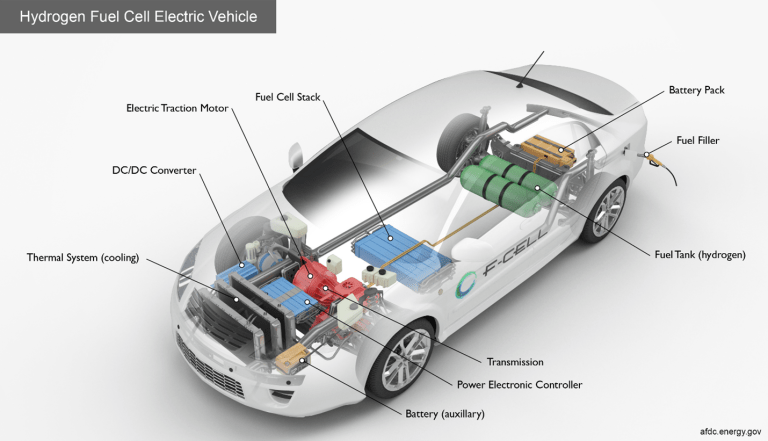
• Hydrogen Tank:
Stores hydrogen fuel to supply fuel cell when needed.
• Fuel cell:
The fuel cell consists of two electrodes, one positive (anode) and the other negative (cathode), and is mediated by an electrolyte, The electrolyte consists of a PEM (Polymer Electrolyte Membrane), which serves as the medium for the fuel cell's operation, and the method of work of the fuel cell is as follows:
1- Two pipes extend to the fuel cell, one from the tank to introduce hydrogen and one from an external air outlet to introduce oxygen.
2- Hydrogen molecules enter the cell and pass through the positive electrode (anode). The catalyst in the electrode causes a chemical reaction that separates the hydrogen into positively charged ions (protons) and negatively charged electrons.
3- The PEM Polymer Electrolyte Membrane allows positive ions to pass through to the negative electrode (cathode), while the electrons carrying negative charges flow through an external circuit to supply energy to the engine.
When the positive ions reach the negative pole (Cathode), two elements are inserted on them:
Oxygen through its tubes
Electrons with negative charges after they exit the engine.
These three elements combine to form water
– in the gaseous state – and are ejected via a separate outlet to the outside of the vehicle.
To understand how the fuel cell works, look at Figure(9)، where the lamp can be replaced by any electrical load in our case here (vehicle engine)

Electric Vehicles... What Next?
Electric Vehicles currently have a lower driving range per full charge than conventional vehicles per full fuel fill. However, the presence of these elements on highways necessitates specific standard specifications to ensure traffic safety and efficiency. For example, high temperatures require excellent battery cooling, increasing energy consumption.
It is worth mentioning that electric vehicles may be more efficient for use within the city than on highways because different stopping conditions, such as traffic lights and toll gates, help generate power from brake pressure, but this feature is not available in all types.
On the other hand, the spread of electric vehicles depends on the availability of appropriate infrastructure, such as charging platforms, fast-charging power stations, and electricity prices, as well as the extent of research and studies on battery efficiency and improving the driving experience, which seems to be making progress since the last ten years, as in Figure (10).
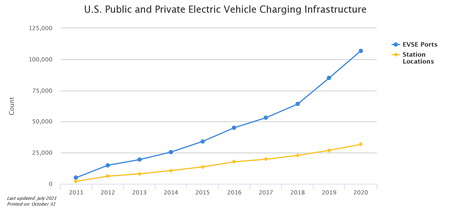
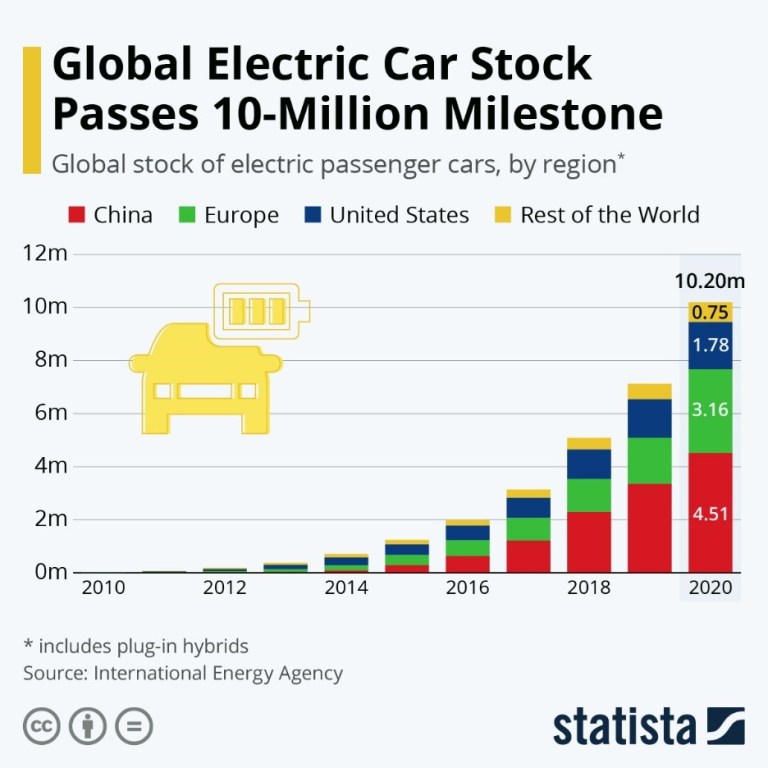
The demand for electric vehicles is continuously increasing worldwide, which can be attributed to the development of electric vehicle infrastructure. As of now, there are approximately 10.2 million electric cars on the road. Figure (11) :
Electric Vehicles in Saudi Arabia
It is impressive to see the Kingdom's commitment to diversifying energy sources and reducing carbon emissions, primarily through initiatives like the Saudi Green Initiative. These efforts are crucial for promoting environmental sustainability and aligning with global goals to reduce carbon emissions by 4% of global contributions. Because electric vehicles are a vital contributor to reducing carbon emissions, there is a tendency to strengthen its presence in the Kingdom.
The Saudi Public Investment Fund's ownership of 67% of Lucid Electric Vehicles, with a significant investment volume of $1.3 billion, showcases the Kingdom's commitment to the electric vehicle industry. The intention of Lucid Electric Vehicles to commence manufacturing in Saudi Arabia in 2024 is a significant development.
On the other hand, the Saudi Standards and Metrology Organization (SASO) has issued a technical regulation for electric vehicles that weigh no more than 3500 kg and have a speed of more than 25 km/h, which are offered in the Saudi markets, whether manufactured or imported from abroad, where the vehicles are tested by the Saudi standards and issued a certificate of conformity by the authority in which it verifies that these vehicles have exceeded the tests of bearing mechanical shocks, protection against electric shocks, insulation resistance and protection from indirect electrical contact and other tests that ensure the presence of vehicles on the roads intact and do not pose a danger to lives. One of the essential topics these regulations cover is batteries in electric vehicles.

The End
Sources
Alternative Fuels Data Center: How Do Hybrid Electric Cars Work? (energy.gov)
Alternative Fuels Data Center: How Do Plug-In Hybrid Electric Cars Work? (energy.gov)
Alternative Fuels Data Center: How Do All-Electric Cars Work? (energy.gov)
Alternative Fuels Data Center: How Do Gasoline Cars Work? (energy.gov)
